


How to Check If a UK Employer Can Sponsor Your Visa Before You Apply
Reviewed by: UK Visa Jobs Editorial Team | Estimated reading time: 10–12 minutes
Every job on UK Visa Jobs is already checked against the Home Office sponsor register before it goes live. But most of your search does not happen here. It happens on LinkedIn, Indeed, Reed, Totaljobs and CV-Library, where nothing is checked at all.
That is where most wasted applications come from. You find a role that fits, you spend an evening on the application, and only after the rejection — or the silence — do you discover the employer could never have sponsored you in the first place.
This guide explains the two questions to ask about any employer before you apply, how to answer them from public data, and how Jobola, a free Chrome extension we built, answers them for you automatically on the job boards where UK Visa Jobs cannot.
In This Article
- The two gates every sponsored job has to pass
- Gate one: can this employer sponsor anyone at all?
- Gate two: does this employer actually sponsor people?
- Why checking by hand does not scale
- What Jobola does on the page
- Where it deliberately says “not sure”
- Free, Premium, and what you get with your UK Visa Jobs plan
- How to install it in under a minute
- Frequently Asked Questions
- Final Thoughts
The two gates every sponsored job has to pass
Most job seekers check one thing: does the advert mention sponsorship? That is the least reliable signal there is. Plenty of employers who sponsor say nothing in their adverts, and plenty who say “we welcome international applicants” have no licence to back it up.
There are two separate gates, and an employer has to be on the right side of both before your application has any chance.
Gate one is legal capacity. Can this organisation sponsor a Skilled Worker visa at all? Only employers holding a sponsor licence from the Home Office can. If the employer is not on the register, no amount of enthusiasm on either side changes that.
Gate two is behaviour. Does this organisation actually use its licence? A licence is permission, not a hiring plan. Many licensed employers sponsor a handful of senior roles a year and nothing else.
We explain the distinction in depth in Does having a sponsorship licence mean a company is hiring foreigners?. The short version: both gates matter, and most people only ever check the first.
Gate one: can this employer sponsor anyone at all?
The Home Office publishes the register of licensed sponsors as a spreadsheet, updated on most working days. It currently lists around 127,000 organisations, each with the town it is registered in and the visa routes it is licensed for.
Three things about the register trip people up.
It lists legal entities, not brands
The register says “Roofoods Ltd”, not Deliveroo. It says “BT Group”, and EE — a BT brand — does not appear under its own name at all. A search for the name on the advert can come back empty for an employer that sponsors hundreds of people a year.
Several unrelated companies can share a name
Search for “Costa Coffee” and you find four separate franchisees in four different towns, none of them the company that runs the brand. Search for “Subway” and you find more than a hundred. Which one posted the advert you are looking at is not something the register can tell you.
A licence is per route
Some organisations hold a licence only for routes that are no use to a Skilled Worker applicant — Creative Worker, Religious Worker, Seasonal Worker. Around 5,000 registered organisations hold no Skilled Worker licence at all. A green tick on those answers a question you were not asking.
You can browse the register on UK Visa Jobs at our licence holders page, which is searchable and kept current.
Gate two: does this employer actually sponsor people?
Every year the Home Office releases figures showing how many Certificates of Sponsorship each employer issued. A certificate is issued for each person an employer actually sponsors, so the count is the closest thing to a track record that exists.
The figures are striking. Of roughly 127,000 licensed organisations, only around 9,500 — about 7% — appear in the 2025 release at all. The other 93% issued too few certificates to be listed, or none.
That is the number that should change how you read a job advert. A licence tells you the door is not locked. The certificate count tells you whether anyone has ever walked through it.
Certificate history for individual employers is part of what your UK Visa Jobs subscription gives you, and it is also included in Jobola Premium — more on that below.
Why checking by hand does not scale
You can do all of this manually. Open the register, search the employer name, work out which of the matching entries is the right one, check the route, then look the entity up in the certificate data. Five minutes per employer if you know what you are doing.
The problem is volume. A serious job search means looking at thirty or forty adverts a day. Nobody checks forty employers by hand, so in practice people check none of them and apply on hope.
That is the gap Jobola closes. It does the lookup on every job you see, on the page, before you have decided whether to read the advert.
What Jobola does on the page
Jobola is a free Chrome extension. Once installed it runs on LinkedIn, Indeed, Reed, Totaljobs and CV-Library, and nowhere else. There is no account and no sign-up. The register is downloaded to your own computer and every check happens there; your job searches never leave your browser.
On a results page
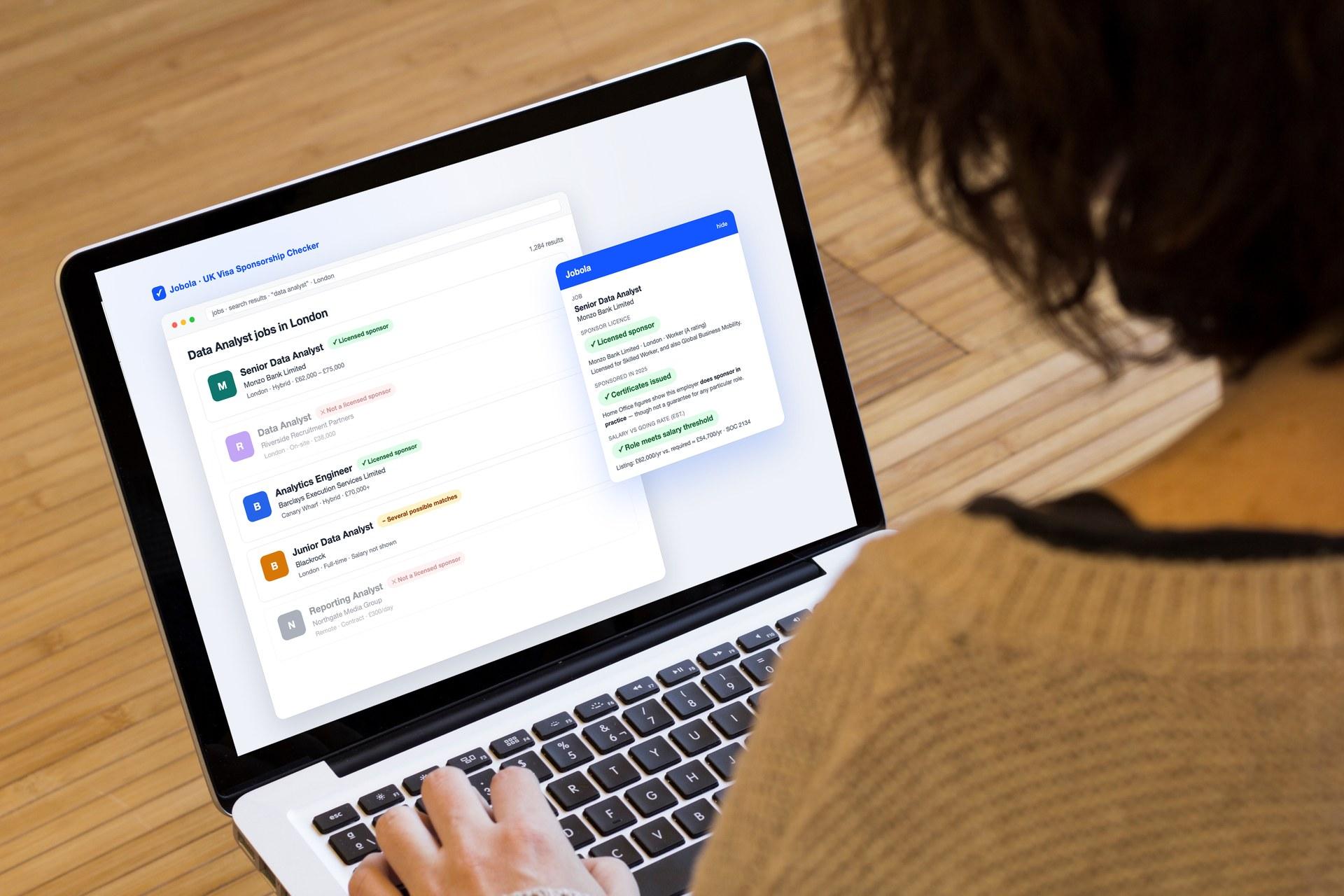
Every job card gets a small pill next to the title: Licensed sponsor, Not a licensed sponsor, or Several possible matches. You can read a whole page of results at a glance and skip the ones that were never going to work.
On a job you open
A panel appears in the corner with the full picture: the exact registered entity that holds the licence, its town, and the routes it is licensed for. Where a brand hires through a parent company — EE through BT Group, for example — Jobola says so rather than reporting the brand as unlicensed.
Ambiguity is reported, not hidden
When several registered companies share a name and it is not possible to tell which one is hiring, Jobola shows an amber “several possible matches” and lists them, instead of picking one. Where the certificate data settles it — one of the candidates sponsors hundreds of people and the others sponsor nobody — it says which and explains why.
Where it deliberately says “not sure”
The most dangerous thing a tool like this can do is give a confident wrong answer. So Jobola is built to hedge rather than guess.
It will not assert a match unless the name is close enough to be sure. It will not resolve a shared name by string similarity. It will not treat a Creative Worker licence as a Skilled Worker licence. And it never tells you that you personally qualify for anything — it reports what published government data says about the employer and the advert, and nothing about you.
That last point matters. Whether an employer will sponsor a particular role is their decision. Whether a visa is granted is the Home Office’s. Jobola predicts neither. It just makes sure you are not applying through a locked door.
Free, Premium, and what you get with your UK Visa Jobs plan
The licence check is free, on every job, with no limit. That is the part we think is too important to charge for.
Jobola Premium adds four things: how the advertised salary compares with the Skilled Worker going rate for that occupation, including the new entrant and PhD discount rates; the employer’s certificate history; detection of sponsorship wording buried in the advert text, quoted back to you; and a filter that dims or hides every non-sponsor on a results page.
Premium is sold as one-off passes, not subscriptions: a month for £4.99, six months for £19.99, or a lifetime pass for £39.99. One payment, no card kept on file, nothing to cancel.
If you are on the UK Visa Jobs Achieve plan, Jobola Premium is included. Your licence key is in the email we sent you; paste it into the extension’s settings and it activates. If you cannot find it, have it resent here using the email address on your subscription.
How to install it in under a minute
Open the Jobola page on the Chrome Web Store and click Add to Chrome. Chrome will ask you to confirm the sites it runs on — the five job boards and gov.uk, nothing else.
Then open a job board. If you already had one open, reload the tab. The pills appear on the results page and the panel appears when you open a job. Click the puzzle-piece icon at the top right of Chrome and pin Jobola so the toolbar button stays visible; that is where the filter and the settings live.
It works in Chrome, Edge, Brave and any other Chromium browser. It does not work in Safari or Firefox, and no browser supports extensions on a phone — it is a desktop tool.
Frequently Asked Questions
Does Jobola replace UK Visa Jobs?
No. UK Visa Jobs is where you find sponsored vacancies that have already been verified. Jobola is for everywhere else — the adverts you come across on general job boards where nothing has been checked. They cover different parts of the same search.
Does a green tick mean I will be sponsored?
No. It means the employer holds a Skilled Worker sponsor licence, so sponsoring you is possible. Whether they will do it for this role is their decision, and the certificate count is the best guide to how often they say yes.
Is my browsing sent anywhere?
No. The register and salary tables are downloaded from gov.uk to your computer, and every check runs locally. The only thing the extension ever sends is a licence key, if you have one, to confirm it is valid. The privacy policy sets this out in full.
The pill says “not a licensed sponsor” but I know the company sponsors. Why?
Usually because the advert names a brand and the licence is held by a differently named legal entity, or because the advert was posted by a recruitment agency rather than the employer. Open the job: the panel lists similar names on the register so you can see whether one of them is the real employer. If you spot a brand that should resolve and does not, email us; these are quick to fix.
Why does it say “several possible matches” for a big employer?
Because several registered organisations share that name and the advert does not say which one is hiring. Jobola would rather tell you it is unsure than pick one and be wrong. Where the certificate data makes it clear, it resolves and tells you why.
Is the salary check reliable?
It is an estimate, and it says so. The occupation code is inferred from the job title, and where the title does not match any published occupation clearly, Jobola compares against the general threshold only and tells you it has done that. For health, care and teaching roles, which have their own pay scales, treat it as a rough guide.
Do I need a UK Visa Jobs account to use it?
No. Jobola has no accounts at all. Install it and it works.
Final Thoughts
The single most useful habit in a sponsored job search is checking the employer before you check the job description. Two questions: can they sponsor, and do they. The first is public record; the second is public data. Neither takes long to answer, and both are answered for you automatically once Jobola is installed.
Use it on the boards where nothing is verified, and keep browsing verified sponsored vacancies on UK Visa Jobs for the roles where the checking has already been done. Between the two, you should never again spend an evening applying through a locked door.
About This Guide
This guide was written by the UK Visa Jobs editorial team, who track the Home Office sponsor register and certificate releases as part of maintaining the UK Visa Jobs listings. Jobola is built and maintained by the same team.
Our guides are reviewed periodically and updated when the underlying data or rules change.
Disclaimer
This article and the Jobola extension provide information drawn from published UK government sources. Neither constitutes legal or immigration advice, and neither assesses any individual’s eligibility for a visa. Sponsor licence status, salary thresholds and going rates change; always verify against GOV.UK before making a decision, and consult a regulated immigration adviser about your own circumstances.
